






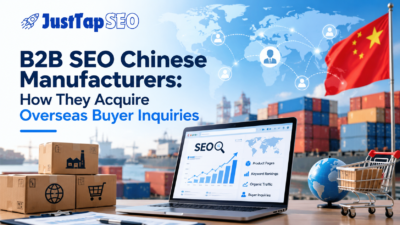
Chinese manufacturers can use B2B SEO to attract overseas buyers by improving their websites, targeting the right search keywords, publishing useful product content, and making it easy for buyers to request quotes. Instead of depending only on B2B marketplaces, trade shows, or sales agents, manufacturers can use Google to reach companies that are already looking for their products.
For example, a US company looking for a custom metal parts supplier may search for “custom metal parts manufacturer China” or “CNC machining supplier for small production runs.” If a Chinese manufacturer’s website provides the right information and appears in relevant search results, the buyer may visit the site and send an inquiry.
This is the main purpose of B2B SEO Chinese manufacturers need: to help international buyers discover their products and turn website visits into business opportunities.
However, getting traffic is not enough. Manufacturers need visitors who are interested in placing orders, checking product specifications, finding a reliable supplier, or discussing custom production. This guide explains how Chinese manufacturers can improve their international SEO, build trust, and generate more qualified buyer inquiries.
Why SEO Matters for B2B SEO Chinese Manufacturers
Many Chinese manufacturers use platforms such as Alibaba, Made-in-China, and Global Sources to find international customers. These platforms can be useful, but a company should not depend on them as its only source of leads.
A manufacturer’s own website gives it more control over product information, branding, customer data collection, and the inquiry process. It also creates another way for overseas buyers to discover the business through search engines.
Understand what overseas buyers search for
International buyers usually search with a clear purpose. They may want a supplier, a specific product, a custom manufacturing service, or a factory that can meet certain quality standards.
Common search types include:
- Product searches: stainless steel water bottles manufacturer, industrial valves supplier.
- Supplier searches: plastic injection molding factory China, wholesale furniture manufacturer.
- Custom production searches: OEM electronics manufacturer, custom metal stamping supplier.
- Problem-based searches: how to choose a packaging supplier, food-grade plastic packaging requirements.
- Comparison searches: custom manufacturing vs. off-the-shelf products.
Manufacturers should research the terms their buyers use instead of only targeting general words such as “factory” or “manufacturer.”
Focus on business inquiries, not just website traffic
A website can receive thousands of visits without generating useful leads. For B2B companies, a smaller number of relevant visitors may be more valuable than a large number of people who are not looking to buy.
For example, a buyer searching for “custom aluminum extrusion manufacturer” may have a stronger buying intention than someone searching for “what is aluminum.”
The first search is more closely connected to finding a supplier. Therefore, manufacturers should focus on keywords that match their products, services, order requirements, and target markets.
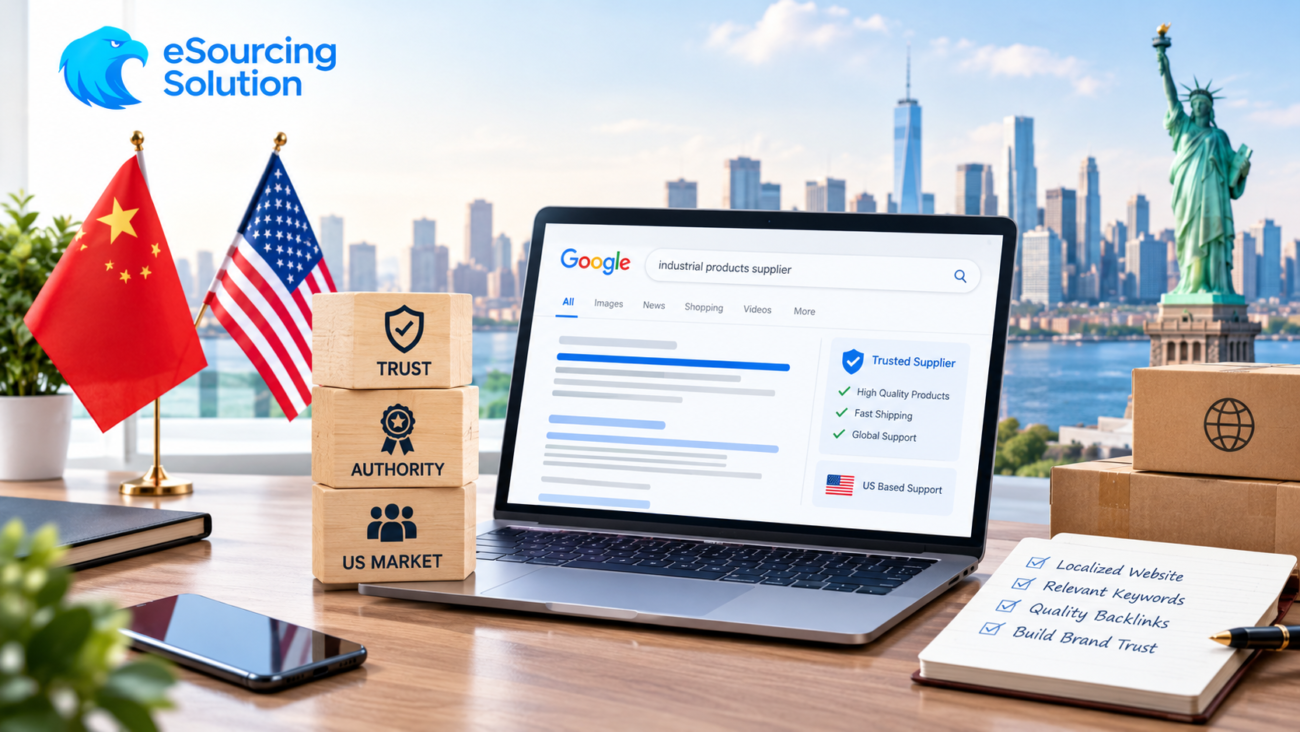
Read more on US Localization SEO Strategy: How Chinese Companies Build Trust and Authority in American Markets
Build a Website That International Buyers Can Understand
A website is often the first place where a potential buyer checks whether a manufacturer is suitable for their business. If the website is confusing, incomplete, or difficult to use, buyers may leave and contact another supplier.
Organize pages around products and services
Do not put every product and service on one general page. Create separate pages for important product categories, manufacturing processes, and services.
A simple website structure could look like this:
| Website page | Main purpose |
| Homepage | Explain what the company makes and which markets it serves |
| Product category pages | Introduce major product groups |
| Individual product pages | Show specifications, uses, materials, and options |
| Manufacturing services | Explain OEM, ODM, custom production, or other services offered |
| Industries served | Explain which business sectors the company supports |
| Quality and certifications | Show relevant quality processes and verified certifications |
| About the factory | Explain experience, production capacity, and facilities |
| Contact or RFQ page | Help buyers request a quote or discuss a project |
Each important page should answer a specific buyer question. For example, a product page should explain what the product is, which materials and sizes are available, and whether customization is possible.
Make the website suitable for international markets
A Chinese-language website alone may not be enough if the company wants buyers from the US, Europe, the Middle East, or other regions.
An English version is a useful starting point. Manufacturers targeting several markets may also need localized pages that consider local terminology, measurement units, regulations, and buyer expectations.
Google recommends using separate URLs for different language versions and using hreflang annotations where appropriate. This helps Google understand which language or regional version may be suitable for a searcher. Read Google’s guide to multilingual and multi-regional websites.
Avoid translating the website word for word without checking how overseas buyers describe products. A phrase used in the Chinese market may not be the same phrase buyers use in the US or Germany.
Create Content That Helps Buyers Make Decisions
Content is an important part of international SEO because buyers need information before they choose a supplier. Manufacturers should create pages that answer real questions instead of publishing general articles only to add more content to the website.
Use product pages, guides, and comparison articles together
Product pages should target searches related to buying or finding a supplier. Educational articles can help buyers who are still researching their options.
For example, a manufacturer of industrial packaging could create:
- Product pages for different packaging materials and sizes.
- A guide explaining how to choose packaging for international shipping.
- An article comparing different packaging materials.
- A page explaining its custom printing and manufacturing options.
- A guide to the product testing and compliance requirements relevant to its target markets.
These pages support different stages of the buying process. A person reading a general guide may not be ready to place an order, but they may become a potential customer later.
Answer the questions buyers ask before contacting a factory
Useful content should cover practical questions such as:
- What is the minimum order quantity?
- Can the factory make custom designs?
- What materials and sizes are available?
- How long does production usually take?
- What quality checks are performed?
- Can the company provide samples?
- Which export markets does it serve?
- What information is needed for a quotation?
Only publish information the company can confirm. If production time or minimum order quantity changes according to the product, explain that instead of giving one figure for every order.
This approach also supports answer engine optimization (AEO). Clear headings, direct answers, useful tables, and accurate product details make information easier for both people and search systems to understand. There is no guaranteed way to appear in AI-generated answers, but clear and reliable content gives buyers a better experience.
Build Trust With Overseas Buyers
An international buyer may be contacting a factory located thousands of kilometers away. They need enough information to decide whether the company is real, capable, and suitable for their order.
SEO can help bring buyers to a website, but trust is what encourages them to take the next step.
Show real factory and product information
Manufacturers should include useful evidence of their capabilities, such as:
- Real factory and production photos.
- Product images from different angles.
- Machinery and production process information.
- Quality control procedures.
- Verified certifications, where relevant.
- Export experience and supported markets.
- Case studies or project examples that the company has permission to share.
Avoid using generic stock photos as if they show the actual factory. Buyers may want to verify the supplier before sending drawings, paying for samples, or placing an order.
If the company has ISO certification or other industry certifications, show the correct details and make sure the certification is current and applicable to the business.
Explain what makes the manufacturer a suitable supplier
A manufacturer does not need to claim it is the best factory in China. It should explain its actual strengths.
For example, a factory may specialize in low-volume custom orders, a particular material, complex product designs, or large production runs. These details help buyers understand whether the company matches their needs.
Clear information is more useful than broad claims such as “best quality” or “lowest price” without evidence.
Read more about Amazon SEO + Google SEO Dual-Track Strategy: Complete Guide for Amazon SEO Chinese Sellers
Turn Search Visitors Into Qualified Inquiries
A visitor may be interested in a product but still leave without contacting the company. The website should make the next step clear and simple.
Make it easy to request a quote
Place a visible call to action on important product and service pages. Common options include:
- Request a Quote
- Send Your Product Specifications
- Discuss a Custom Order
- Request a Sample
- Contact Our Sales Team
The call to action should match the page. For example, a custom manufacturing page can invite visitors to send their drawings or project requirements.
The contact form should collect enough information to help the sales team respond without making the process unnecessarily difficult.
| Form field | Why it matters |
| Name and business email | Helps the sales team identify and contact the buyer |
| Company name and country | Gives basic information about the business |
| Product or service required | Shows what the buyer needs |
| Estimated quantity | Helps assess the size of the opportunity |
| Specifications or drawings | Helps understand technical requirements |
| Expected order date | Gives an idea of the buyer’s timeline |
Not every field must be mandatory. A short form may work better for an early-stage visitor, while a detailed RFQ form may suit buyers who already know what they need.
Track the quality of inquiries
Manufacturers should measure more than website visits and keyword rankings. They also need to know whether SEO is bringing potential customers.
Useful metrics include:
- Organic traffic to product and service pages.
- Search impressions and clicks.
- Visits from target countries.
- Quote requests submitted through the website.
- Qualified inquiries that match the company’s products and order capacity.
- Sales opportunities and orders influenced by organic search.
A qualified inquiry is one that fits the company’s products, market, capabilities, and commercial requirements. The exact definition will depend on the business.
For example, a factory that specializes in bulk orders may not consider a request for ten pieces a qualified lead. Another factory focused on prototypes may welcome it.
Technical SEO for Manufacturing Websites
Even good content may struggle to perform if search engines cannot properly access or understand the website. Technical SEO helps make important pages easier to crawl, index, and use.
Manufacturers should start with the following checks:
Mobile usability: Product pages, images, menus, and inquiry forms should work properly on mobile devices.
Page speed: Large factory images and product videos can slow down a website. Compress media files and avoid unnecessary scripts.
Indexing: Important product pages should be accessible to search engines and should not be blocked by accidental settings.
Site structure: Use clear navigation and link related product pages, technical guides, and service pages together.
Duplicate pages: Avoid creating many nearly identical pages with only a product name or country changed. Each page should provide useful, relevant information.
Structured data: Where appropriate, use valid structured data to help search engines understand product information and other page details.
Language versions: Use clear language-specific URLs and correctly implemented hreflang annotations when the site has different language or regional versions.
A technical SEO audit can help identify problems before a manufacturer spends time creating more content.
Adjust SEO to the Manufacturing Industry
Not all manufacturers should follow the same content strategy. The keywords and information that matter depend on what the company produces and who buys it.
| Industry | Example keyword focus | Useful content |
| Industrial machinery | Industrial machinery manufacturer China | Machine specifications, operating requirements, maintenance information |
| Electronics | OEM electronics manufacturer | Customization options, testing, production capabilities |
| Furniture | Commercial furniture manufacturer | Materials, dimensions, finishes, bulk order options |
| Packaging | Custom packaging manufacturer | Materials, printing options, sizes, minimum quantities |
| Metal products | CNC machining supplier China | Materials, tolerances, machining capabilities, drawings |
| Textiles | Private label clothing manufacturer | Fabric options, samples, sizing, production capacity |
These are starting points, not a complete keyword list. Each manufacturer should research the actual terms used by its buyers.
For example, a machinery company may need detailed technical pages, while a clothing manufacturer may get more value from pages about fabric choices, private labeling, samples, and minimum order quantities.
The main goal is to connect search terms with the right products and the information buyers need to make a decision.
Support SEO With B2B Directories and Trade Shows
A manufacturer’s website should be its main information source, but other channels can also help buyers discover the company.
B2B directories such as Alibaba.com and Made-in-China.com can help manufacturers reach buyers who are already searching for suppliers. Industry directories and trade associations may also provide useful visibility when they are relevant to the business.
Manufacturers should keep their company name, website, product descriptions, and contact details consistent across important profiles. They should also use original product descriptions instead of copying the same text everywhere.
Trade shows can support digital marketing as well. Before an event, a manufacturer can publish a landing page explaining which products it will showcase. After the event, it can share product updates, technical guides, or answers to questions raised by buyers.
Where appropriate, manufacturers can also publish authorized event recaps and link to relevant product pages. Any links from external websites should be earned naturally through useful information and genuine business relationships, not purchased in ways that violate search engine guidelines.
These activities should support the main SEO strategy rather than replace it.
A Practical 90-Day SEO Plan for Chinese Manufacturers
Manufacturers do not need to optimize every page at once. A simple 90-day plan can help the team focus on the most important tasks first.
| Period | Main tasks | Expected output |
| Days 1-30 | Research target buyers and keywords, audit the website, check indexing, review competitors | SEO audit, keyword list, priority page list |
| Days 31-60 | Improve homepage and product pages, fix key technical issues, improve inquiry forms | Better product information and clearer contact paths |
| Days 61-90 | Publish useful buyer-focused content, improve internal links, review search performance and inquiries | More complete website content and a baseline for measuring results |
What should the company review after 90 days?
Check whether search engines are discovering the right pages, whether impressions and clicks are changing, and whether visitors from target markets are reaching product pages.
SEO results vary by industry, competition, website history, and the amount of work completed. Some technical improvements can be seen relatively quickly, while stronger rankings and qualified inquiries may take several months or longer.
Do not judge the whole strategy only by rankings for one keyword. Review the wider group of product-related searches and whether the website is generating useful business conversations.
The sales team should also share feedback with the SEO team. If buyers repeatedly ask about certifications, lead times, or minimum quantities, that may show where the website needs more information.
Conclusion
B2B SEO Chinese manufacturers use can help them reach overseas buyers who are actively searching for products, suppliers, and custom manufacturing services. A well-organized website, useful product content, relevant keywords, technical SEO, and clear inquiry forms all help make the business easier to find and evaluate.
Manufacturers should start with their most important products and target markets instead of trying to optimize everything at once. They should also show real evidence of their capabilities and make it simple for buyers to request a quote.
SEO is not an instant source of orders, but consistent work can help manufacturers build a stronger online presence and reduce their dependence on a single lead source. Most importantly, they should measure qualified inquiries and sales opportunities, not only website traffic.
If your company wants to improve its international search visibility and attract more overseas buyers, book a free consultation with JustTapSEO to discuss a practical B2B SEO strategy for your manufacturing business.
FAQs
1. What is B2B SEO for Chinese manufacturers?
B2B SEO helps Chinese manufacturers improve their visibility on search engines so international businesses can find their products and services. It includes keyword research, product page optimization, useful content, technical SEO, and lead generation improvements.
2. How can Chinese manufacturers get more overseas buyer inquiries?
Manufacturers can create detailed product pages, target keywords used by international buyers, show verified factory and quality information, publish useful industry content, and make it easy to request a quotation. They should also track which pages generate qualified inquiries.
3. How long does B2B SEO take to generate inquiries?
The timing varies depending on competition, website quality, target keywords, and the work involved. Some improvements may show results within a few months, but competitive international SEO often requires ongoing effort. There is no guaranteed ranking or lead-generation timeline.
4. Should Chinese manufacturers use B2B marketplaces or their own websites?
Both can be useful. B2B marketplaces help manufacturers reach buyers who use those platforms, while their own websites give them more control over product information, branding, and inquiry forms. Using both channels can reduce dependence on one source of leads.
5. Which keywords should Chinese manufacturers target for international SEO?
They should focus on relevant product, supplier, manufacturer, OEM, ODM, custom production, and industry-specific terms. The best keywords depend on the products, target countries, buyer requirements, and the company’s manufacturing capabilities. Keyword research should guide the final selection.